
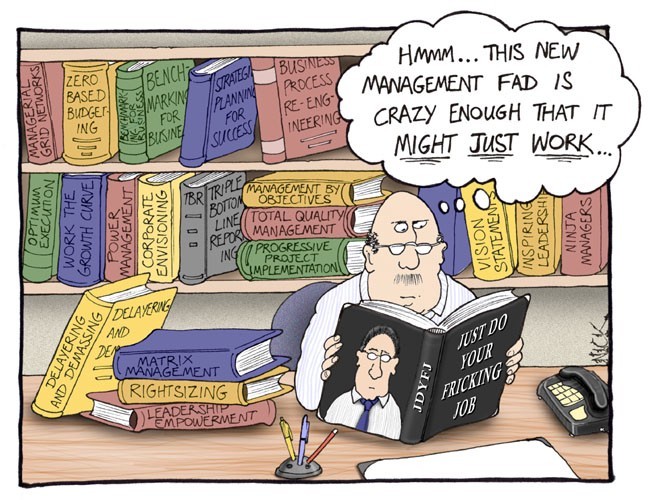
Great ideas like Reengineering, 360-degree feedback, Open office culture, Customer delight, Core competency and few similar business philosophies are so impressive. I always thought such ideas are sufficient to take a company to greater heights and companies need to look no further than these. Later I realized that the same mantras/ solutions that companies strongly believed, supported and adopted at one point got replaced with new, emerging and trendy mantras, solutions or philosophies. It is surprising that the previous mantras that dominated the work environment for few years even fade away from collective memory. People happily start chanting the virtues of novel mantras and solutions, propounded by new management gurus through their best sellers. Few years back, a senior industry leader offered ‘mindfulness’ (an emerging trend at that time) as a general prescription for all the ills of the industry.
Management fad is a term used to characterize a change in philosophy or operations implemented by a business or institution. (Source: Wikipedia. Reproduced verbatim)
The term is subjective and tends to be used in a pejorative sense, as it implies that such a change is being implemented (often by management on its employees, with little or no input from them) solely because it is (at the time) "popular" within managerial circles, and not necessarily due to any real need for organizational change. The term further implies that once the underlying philosophy is no longer "popular", it will be replaced by the newest "popular" idea, in the same manner and for the same reason as the previous idea. (Source: Wikipedia. Reproduced verbatim)
Management fads are often characterized by the following: (Source: Wikipedia. Reproduced verbatim)
•New jargon for existing business processes.
•External consultants who specialize in the implementation of the fad.
•A certification or appraisal process performed by an external agency for a fee.
•Amending the job titles of existing employees to include references to the fad.
•Claims of a measurable business improvement via measurement of a metric (e.g. key performance indicator) that is defined by the fad itself.
•An internal sponsoring department or individual that gains influence due to the fad/s implementation.
•Big words and complex phrases (puffery).
These fads have a life cycle on their own. An idea comes into existence through a book/speech/ research work. Some give a rave review about the idea and opine that it can offer solutions the industry is longing for. People become curious, explore the idea a bit and start supporting it. The proponent of the idea is regarded as a management guru. He starts writing and speaking more. He expands the idea. More books and literature emerge. Some companies start using the idea and declare early success, which prompts more companies and industry bodies to jump into the bandwagon.
Now, everyone talks only good things about the idea. Any doubts about its efficacy are brushed aside. Leaders introduce the idea in their organizations, take credit for the initiative and rush to declare success. An initiative that gets implemented across an organization gives employees and managers great hope and engages them for some time. Experts and consultants emerge, play their part and pocket some money too. The idea is widely present.
As with any life cycle, after the growth and maturity phase, a steep decline is inevitable.
The idea loses its charm. The fatigue factor sets in. The original supporters of the idea move on to support another fancy idea that is gaining popularity. Slowly the older idea is pushed into oblivion.
As management professionals, what management fads have you have come across in the past?
What fads are you witnessing in the recent times?
Please write them in the comments box. It will help the young managers in this forum.