
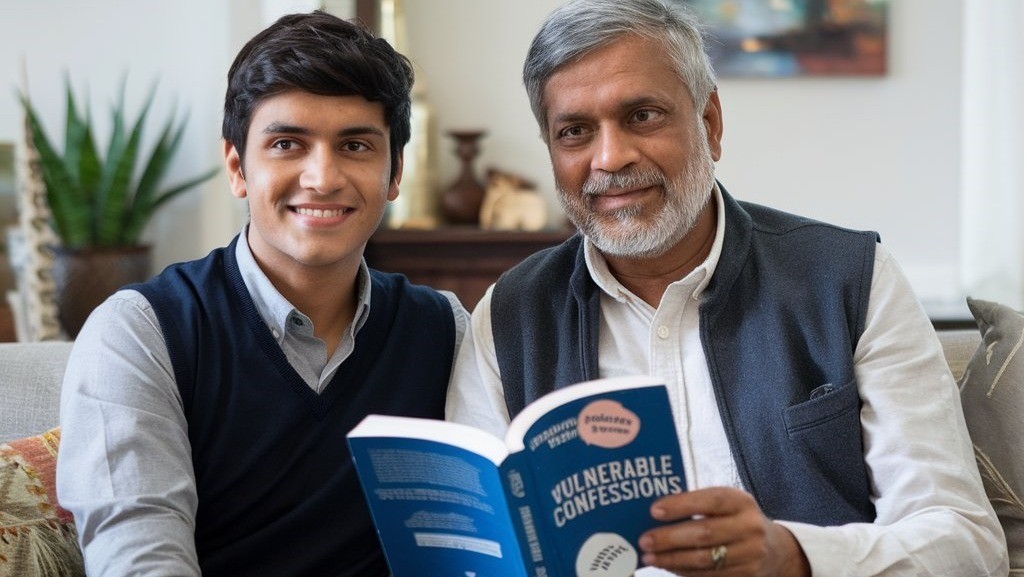
"People respect strength, but they connect with vulnerability." – Brené Brown
In this series we are going to look at conversations that can bring forth profound connections with people. We are starting with Vulnerable Confession and how it creates solid connections with people.
(Two old friends, Rahul and Sunil, sit on a park bench meeting after years of living away from each other)
Rahul: Sunil, I always envied you. You had it all figured out—career, family, savings, job after retirement, and everything else.
Sunil: (laughs softly) that’s funny Sunil. I always thought that you were brave. You took risks, followed your passion and lived the life on your terms. I never had the courage you had.
Rahul: (pauses) I was never really that brave Sunil. I had my own doubts and insecurities. But, somewhere I wanted to show that I was brave and hence took some risks that even backfired completely. I was really scared of sharing those failures with our people and hence chose to live in faraway cities.
Sunil: I understand you completely Rahul. Many of us run away from situations that need to be faced and I am no exception to this.
Let us hear another conversation between a father and his grown-up son, few minutes after a heated argument between them.
Father: Forgive me for what has happened now. When I was your age, I was failing in many aspects …low marks in college, could not get a first job etc. My father never told me he was proud of me, and I spent my whole life trying to be good enough, to meet his expectations. And because of that, I expected too much from you early on. I could sense the pressure you are going through.
(The son, who always felt pressured, looks up in surprise.)
Father: I just don’t want you to feel the way I did. But in trying to help you grow and succeed, maybe I made you feel like you weren’t enough. I’m sorry for that.
(After a long silence the son finally speaks in a softer voice)
Son: I always thought you were just hard on me because I was a disappointment. I never knew the feelings you had for me and your commitment towards my growth.
(In that moment, the wall between them begins to crumble, making space for deeper and honest relationship.)
A husband and wife sit on the balcony, watching the city lights. The tension between them is thick. Unspoken worries have kept them distant for weeks.
Husband: (softly) I need to tell you something. And I don’t know how to say it without sounding weak.
Wife: (turns to him) You can tell me anything.
(He exhales slowly, staring at his hands. His voice trembles, but he speaks anyway)
Husband: I feel like I am failing you. As a husband, as a provider, as… everything. You are working so hard, supporting and standing by me, taking care of our family. I am not sure if I do anything great for you. And I keep wondering if you regret choosing me.
(Silence. The weight of his words lingers in the air.)
(The wife’s eyes well up. She gently places her hand over his.)
Wife: (whispers) Do you think I regret choosing you?
(She shakes her head, gripping his hand tighter.)
Wife: I married you because I love you, not because of what you do or don’t do. I have seen your best days and your worst, and I am still here. And if you are scared, then tell me. But, please don’t shut me out. I would prefer being with you and fighting life with you rather than watch you fight alone.
Husband: (quietly) I don’t want to fight alone. I dread that.
Wife: (soft smile) Then don’t. I am with you always.
(She leans her head on his shoulder, and for the first time in a long time, they just sit there—together, no masks, no fears, just love.)
What Is a Vulnerable Confession?
A vulnerable confession is when a person openly shares his deepest thoughts, fears, mistakes, regrets, or emotions without hiding behind pretense or pride. It is an act of courage and honesty, where one chooses to be seen as they truly are—with flaws, insecurities and shortcomings.
Unlike casual confessions (I should not have left that job or I should have helped you that day), a vulnerable confession reveals something deeply personal—a past failure, an unspoken longing or a truth that was never voiced before.
How it Strengthens Connections?
- Creates Emotional Depth: When someone confesses something vulnerable, it shifts the conversation from surface-level interactions to a place of genuine emotion and authenticity. It allows both people to engage in a real, raw human experience.
- Builds Trust: Vulnerability signals, “I trust you completely.” This encourages the other person to lower their guard and reciprocate with their own honesty. It strengthens relationships—whether between friends, partners, colleagues, or even strangers.
- Breaks the Illusion of Perfection: Many people wear masks to appear strong, competent or unaffected. A vulnerable confession reminds us that everyone struggles, everyone gets hurt, and no one has it all figured out in life. This can be incredibly liberating and comforting.
- Encourages Deeper Empathy: When someone shares a deeply personal fear or struggle, the listener often feels closer to them because they recognize parts of themselves in the confession. It brings out compassion rather than judgment.
Scientific Proof:
- Dr. Paul Zak’s research: When someone shares something deeply personal, the listener’s brain releases oxytocin, the bonding hormone, making them more likely to feel connected, trusting, and emotionally invested.
- The Pratfall Effect: Psychologist Elliot Aronson found that people find others more likable and trustworthy when they admit flaws or mistakes.
- Social Penetration Theory (Altman & Taylor, 1973): Relationships deepen through reciprocal self-disclosure. One vulnerable share encourages another.
Challenges to Vulnerability:
- Fear of Rejection and Judgment: What will they think of me?
- Past Emotional Wounds: “I did it earlier and people made fun of me. I won’t repeat it.”
- Conditioned Belief: Vulnerability is weakness.
- Fear of Losing Control: If I lower my guard, I may fall apart.
- Fear of Burdening Others: Everyone has their problems. I shouldn’t pass mine onto them.
- No One Will Understand: “No one really understands my problem.”
- False Notion of Independence: “I am an independent person. I should deal with everything myself.”
A vulnerable confession when given with sincerity can change relationships, heal wounds, make conversations unforgettable and bring out profound connections. To repeat the quote mentioned in the beginning...
"People respect strength, but they connect with vulnerability." – Brené Brown
What do you feel? Please share your thoughts.