
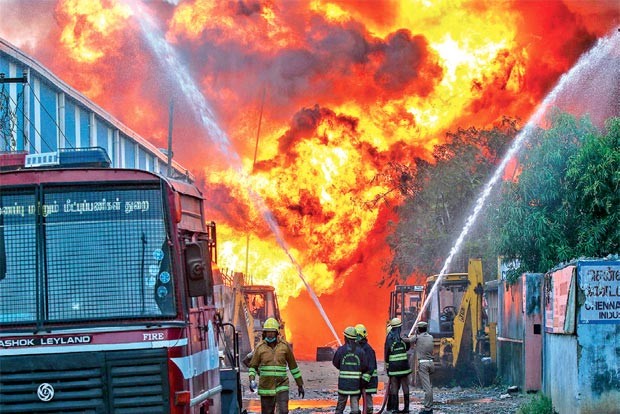
The fire tender comes to screeching halt. A mob gathers around the vehicle and starts abusing the driver and the firemen for coming late. The mob points to the 6 or 7 houses which are completely engulfed in fire and points out the fire spreading fast to other houses in the slum area at Mylapore. The driver is pulled down from the vehicle. Some start punching him, some start abusing while many start blaming him for the loss. The same thing happens to the firemen who get down from the vehicle first. Some wise men in the mob raise their voices and remind others that this not the right time to stop and argue with the firemen.
Now the entire fire brigade gets down from the vehicle and is readying for the task ahead. They start rolling out the hoses and are figuring out from where to start the work. The mob is already restless. They are not able to digest the loss of every precious second. They continue to express their anger on the firemen and the driver for reaching the spot late. The driver gets a big chunk of slaps, abuses and blame because it is he who comes late and hence the losses.
Everyone in the mob seems to have a clear idea about exact time the fire initially started, what time the fire service was alerted, how long does it take for the fire tender to get ready and the travel time from Santhome to the spot in Mylapore by shortest possible route. The overall conclusion is that the fire tender is very late. The delay time varies from person to person – some say it is 10 minutes, while some say it is even 25 minutes.
Now the deluge guns are trained on the fire. Some firemen start rescuing items from the burning houses. The mob shifts its focus on this sight. The driver gets a breather. He walks a distance, finds a quiet place and lights a cigarette. I follow him and strike a conversation. I enquire if he is hurt by the mob and if he needs some help. He responds negatively. I tell him that it is difficult to face an angry mob and showed my concern for him.
He nodded and after a brief pause says that he is absolutely okay with what has happened. He says it is a regular part of his job. I am shocked. I am unable to believe how this can be regular part of someone’s job. He narrates few incidents in which he bore the brunt of angry mobs, particularly in those places where economically weaker sections live. He says he is able to understand their anger, pain of losing houses and belongings, fear of future and the resultant behaviors shown on him. I am amazed by the maturity level of this driver.
At the same time, I could think of highly paid executives who continue to ask:
Why should I get all the abuses and blames when
- my company fails to deliver the machine on time?
- someone else gave a wrong commitment?
- our product fails?
- our network fails?
- someone else dumped stock on dealer?
- the mess was created by another person?
- my company delays the payment?
There can be many, many situations where ‘Why should I get these abuses and blames’ may arise.
People may abuse or blame you because you an inherent part of something …an organisation, hierarchy, deal or a transaction. You need to have the maturity to understand and accept this.
Those who do not want to get these abuses and blames should ideally refrain from being a part of an organisation, hierarchy, deal or a transaction.
This driver is an inherent part of the fire brigade and he completely understands this. He cannot reason out with the mob that his job is merely driving and he is no way connected with the Fire Control Room, the fire officer’s decision to dispatch the brigade, time taken by the firemen to board the vehicle, traffic on road, etc. This maturity helps him to deal with the situation powerfully.
I ask the driver, how does he manage to deal with these scenarios, whenever they happen. He says he follows few simple rules:
1. He doesn’t run way from the situation. He expects and accepts people’s behaviour (If he starts running away, the mob becomes mad, chases him and the implications are huge)
2. He does not get into arguments and explanations
3. He doesn’t even listen to those abuses. He simply ignores them
4. He uses minimum defences to withstand the pull, push and slaps
5. He carries some band aids and ointments, for emergency use
How do we bring in this maturity, acceptance and ability in our people?